 Funlode
Shove Ha’penny
Shove Ha’penny Game comes down to where each coin stops. Slide five coins into three target beds and practice your aim free online on Funlode.
Developed by Funlode · Free to play
- Playable on
- Desktop Touchscreen
What Is Shove Ha’penny Game?
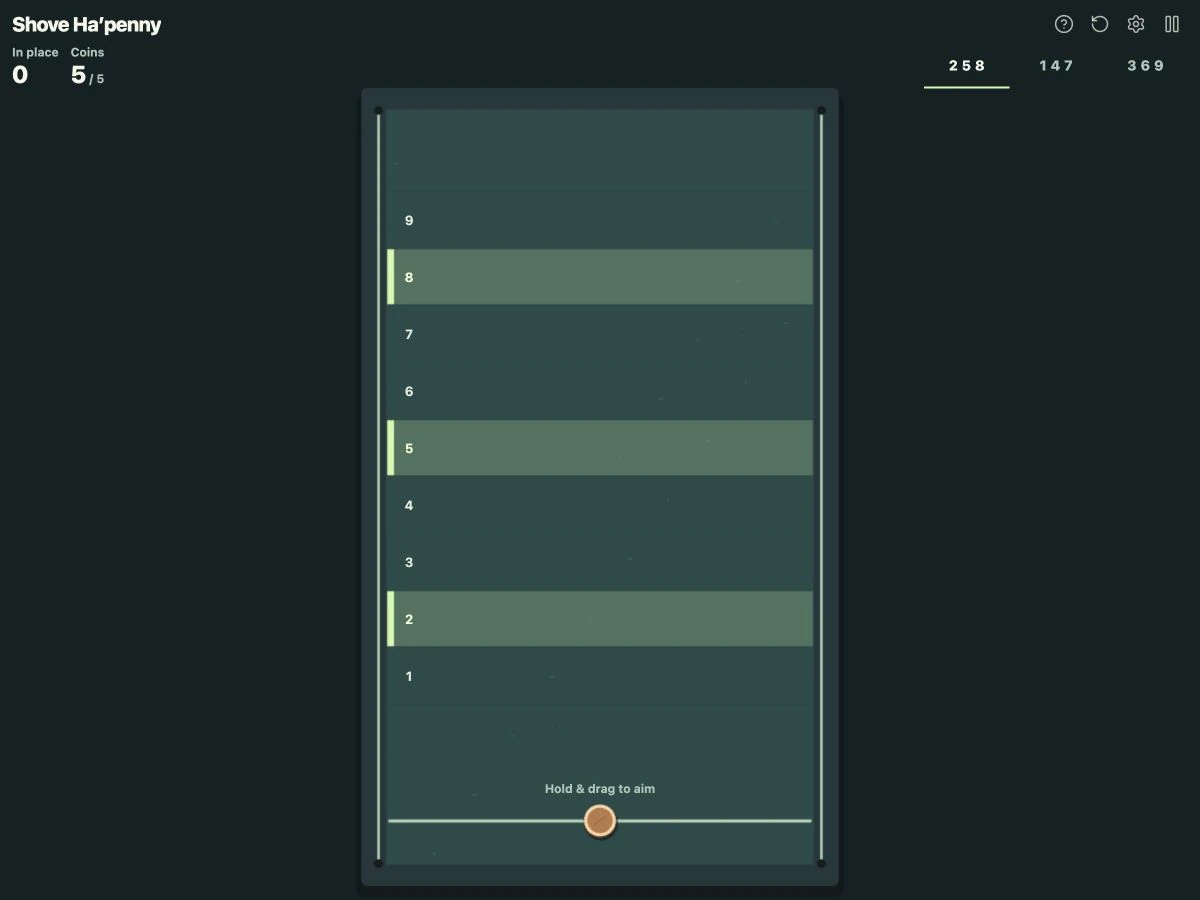
Shove Ha’penny Game is a coin-sliding skill game in which the stopping position matters more than distance. In this free Funlode challenge, you slide five coins toward three highlighted scoring beds.
The challenge uses the aiming and sliding idea of the traditional tabletop game. Here, you complete a hand by covering the three selected targets, with the final coin positions deciding your score.
How to Play Shove Ha’penny Game
- Choose a target set: 2, 5, 8, 1, 4, 7, or 3, 6, 9. Changing the set starts a new hand.
- Hold the coin at the bottom to build power. Drag left or right to adjust its starting position.
- Release to slide the coin. Wait for it and any coins it hits to settle.
- Use all five coins, aiming to leave at least one scoring coin in each highlighted bed.
Keyboard: Use the left and right arrows or A and D to aim. Hold Space to charge and release to shove. Press P to pause or R to restart.
Shove Ha’penny Game Rules
- You have 5 coins per hand and 3 highlighted target beds.
- A coin earns 1 point only when it rests completely inside a highlighted bed. Touching a boundary line or resting in an unhighlighted bed scores nothing.
- Later coins can move earlier ones. Only positions after the fifth coin settles determine the final score.
- Cover all three target beds to complete the challenge. A perfect hand also has all five coins scoring.
- Power reaches full strength in 3.6 seconds. The power marks indicate target windows on a clear board, but collisions can change where a coin stops.
Shove Ha’penny Game Tips
Use the first shot to judge the power needed for the next. If a coin stops too early or too far away, make a small adjustment before changing your starting position as well.
A coin already on the board can block a path or be nudged into a target. Check where all five coins may end up, rather than counting an early point as safe.